
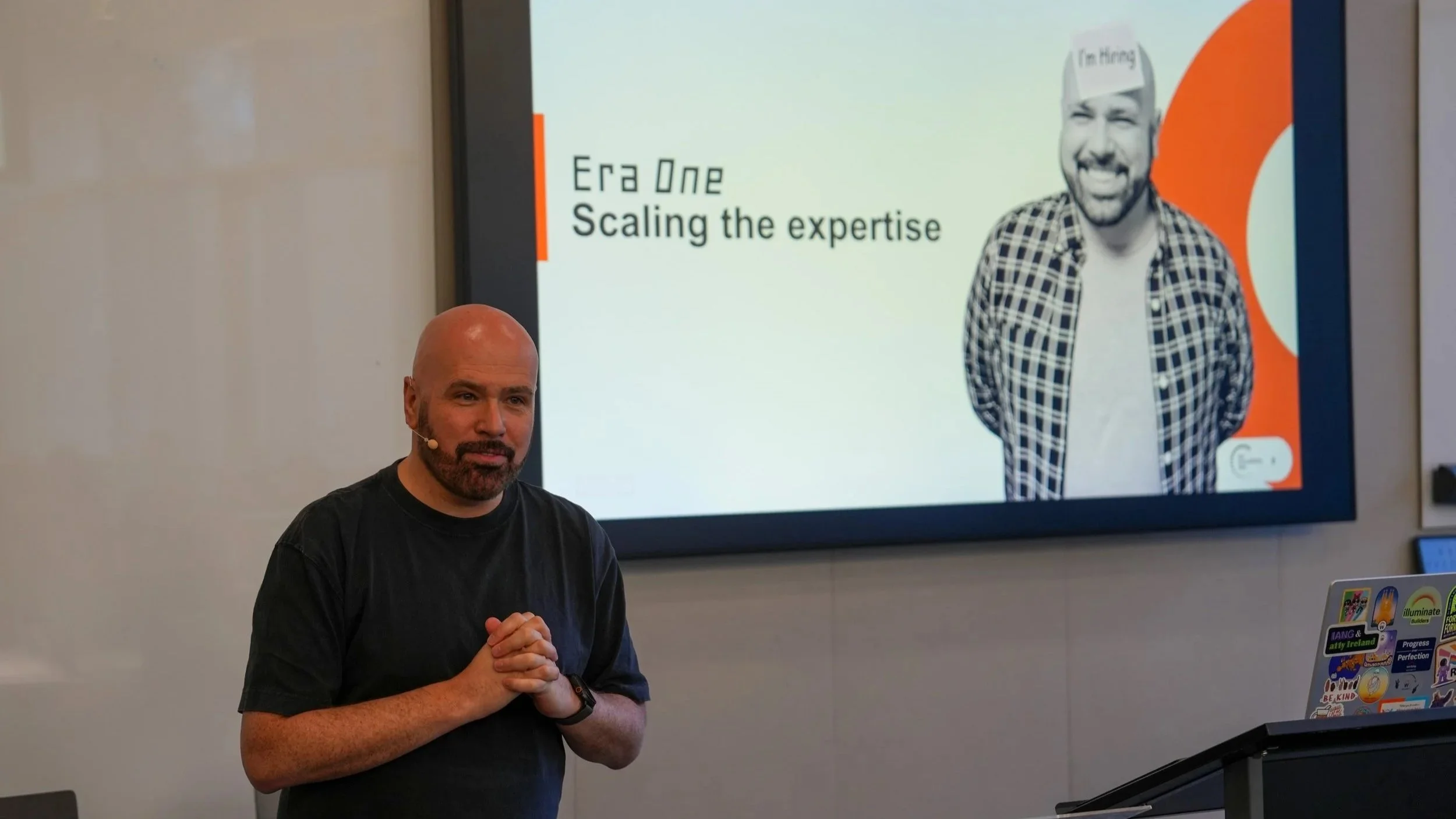
Photo Credit: Wassim Nasr and The Accessibility Dial.
On Thursday 12 November I spoke at The Accessibility Dial in Dublin.
I've been at Optum for 10 years, so I used the talk to look back at what we actually did about accessibility in that time. It came out as three eras. Each one was the right answer when we chose it. Each one hit a ceiling. I'm standing in the third right now.
Era one, 2016. We scaled the expertise.
I was building our Dublin studio at the time, from nothing to 35 people, and later helped scale the practice to around 160 designers globally. In the first year I hired accessibility specialists into Ireland, which sounds unremarkable until you try it. It wasn't a question of salary or competition. The people I needed weren't on the market. So I relocated people from the UK to come and build it with us.
Then we put them inside design and scrum teams rather than in a central group you raised a ticket with. Lunch and learns. Walking the floors. A network of advocates in the teams we knew we would never staff.
It worked, and it didn't scale. Every new product wanted a specialist of its own, and I was hiring and building people up one at a time while the company kept launching. That isn't a strategy problem. It's arithmetic.
Era two, 2020. We scaled the artefact.
So in 2018 I took on the enterprise design system, brought the team together in one place, and we did it properly. We put accessibility inside the team building the system, not reviewing it from the outside. We spent weeks arguing about details you would find absurd, and we only ever had those arguments once. Every team that picked up a component inherited the answer.
That one had a different ceiling. A design system doesn't ask a team to adopt it once. It asks them to keep taking it, every release, forever. Teams that are shipping don't stop shipping to upgrade something that already works. A fix can ship in version four while the teams who need it most are still on version two. The component is perfect. It just isn't anywhere near them.
Era three. Now.
The screen is starting to assemble itself. An agent picks components at runtime and builds an interface that has never existed before and may never exist again. No designer drew it. Nothing caught it in review, because there was nothing to review until the second it appeared.
If you can't inspect the output, you constrain the input. A2UI, the open format Google introduced, already works this way. The agent doesn't write the markup. It declares what it intends the interface to do, and the client renders it from a catalogue of components somebody has already approved.
That gets you accessible components. It does not get you an accessible page. A component knows what it is. It doesn't know what it sits inside, what comes before it, or where focus should land when it appears. None of that lives inside a button.
So accessibility has to move again, into the rules for how the pieces go together. I call that the contract. Structure, reading order, relationships, focus and how a change is announced, written down in a form a machine can act on, because the thing reading a design system isn't only a person any more.
In 2016 accessibility lived in people, and it reached the teams we could staff. In 2020 it lived in the component, and it reached every team that adopted it. In the contract, it can reach screens nobody has designed yet.
Accessibility doesn't scale by adding more people who care. It scales by shrinking the number of decisions where caring is required.
None of that takes the people out. Somebody has to write the contract, and the vocabulary it needs is the one accessibility practitioners have used for decades. It also has to be tested with the people who depend on it.
Era three has only just begun, and I don't have a finished answer. We can describe structure today. Reading order and focus are still being worked out. We're building in it right now and I'll share more as it gets clearer.
If you're working on the same problem, I'd like to hear how you're going at it. Get in touch.